
TABLE OF CONTENTS
PART ONE Page Number
Chapter One: The Basis of Knowledge ………………………………………….….… 9
Chapter Two: The Standard View of Science ………………………………………… 24
PART TWO
Chapter Three: The Relevance of the Social Sciences and Social Science Research… 38
Chapter Four: Historical Research …………………………………………………..… 56
Chapter Five: The Survey Research ……..……………………………………………… 73
Chapter Six: The Case Study Research …………………………………………………. 84
Chapter Seven: The Content Analysis Research ……………………………………….. 97
Chapter Eight: Action Research …………………………………………………………. 112
Chapter Nine: Operations Research ………………………………………………….…. 134
Chapter Ten: Evaluation Research ………………………………………………………. 142
PART THREE
Chapter Eleven: Research Design ……………..………………………………………… 159
Chapter Twelve: Research Methodology …………………………………………….…. 175
Chapter Thirteen: Data Processing, Scaling and Measurement ……….…………..….. 211
PART FOUR
Chapter Fourteen: Statistics in Social Science Research …………………………………223
PART FIVE
Chapter Fifteen: Research Report Writing …………………………………………….… 250
THIS PAGE INTENTIONALLY LEFT BLANK
Preface
“The measure of all things and society,” according to Hippias, “was constructed and did not naturally exist.” Pythagoras of Samos 570-495 BC
“All men by nature desire to know.” This is the opening line of Aristotle’s Metaphysics. It expresses his conviction that the thirst for knowledge is not something limited to full-time thinkers like himself, but it’s something we all share. (Adamson, P. 2011 podcast). Today, observing and then measuring a phenomenon is key to understanding the empirical basis for knowledge. Measurement, an aspect of mathematics, teaches us that every problem has a solution.
My foundational years as a research scholar in India, spanning the period from 2015 to 2019, were distinguished by a continuous schedule of scholarly engagements. Participation in conferences, specialized seminars, and critical viva-voce examinations evolved from occasional occurrences into a regular, highly enriching practice. India, a country celebrated for its intellectual richness and extensive educational infrastructure, possesses a virtually inexhaustible number of universities. This sheer volume of institutions ensures that academic functions are held almost daily. These events are not simply perfunctory; they are intentionally designed to introduce emerging research scholars to the most current theoretical concepts, rigorous methodological approaches, robust analytical frameworks, and the broader intellectual discourses pertinent to their respective fields. It was primarily through the halls of such presentations and interactions, and the encouragement of my research guide, Professor Vishwanatha, that I developed a strong interest in research methodology, as the philosophical approach that leads to understanding a social phenomenon and constitutes factual knowledge.
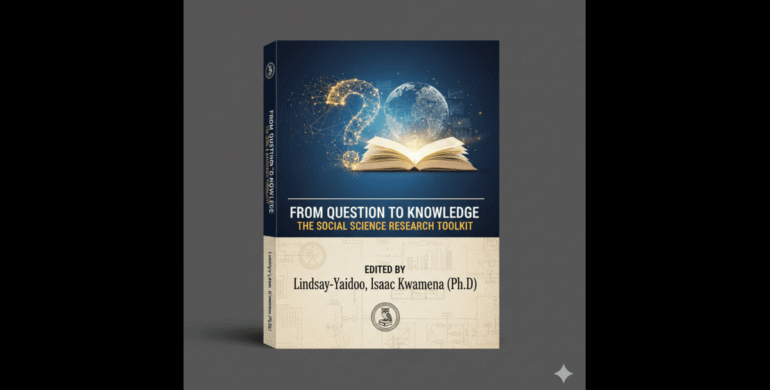
This comprehensive book, titled “From Question to Knowledge: The Social Science Research Toolkit,” serves as an indispensable resource for anyone engaged in or planning to engage in social science research. It was meticulously designed with the explicit goal of becoming a hands-on, practical companion, equally valuable to both prospective students and seasoned, practicing researchers navigating the complexities of the field.
No research is flawless. However, research is not a matter of dogma; it represents disciplined intellectual effort. Every researcher or team of researchers operates within the limitations of current knowledge and understanding. Nevertheless, comprehending the processes that can lead to discoveries regarding social facts and realities can be profoundly empowering.
Every individual is considered a stakeholder in our contemporary world. Consequently, issues such as global warming, universal peace and human dignity, sustainable development, poverty, and injustice constitute challenges that often form the research objectives. Putting each of these variables into context and devising suitable measuring techniques can determine a measurement “status” for each variable for the necessary development actions. Thus, the role of the social scientist is arguably more vital now than ever before.
Contemporary social research, however, has undergone a significant and necessary expansion, away from the traditional focus centered on dissecting and comprehending the intricacies of human thought processes and observable behavior. While the study of individual thought and behavior remains vital, for determining structural predispositions, the current field now extends far beyond the purely psychological or sociological. Current social science research demonstrates heightened dynamism, interdisciplinary, and multidisciplinary engagement. It is also now deeply embedded in the practical realm of policy and public life, focusing on understanding, analyzing, and assessing the developmental milieu of complex systems. This includes, but is not limited to, the rigorous evaluation of:
- Policy and Politics: Analyzing the formation, implementation, and impact of public policies; investigating political behavior, electoral dynamics, and the structure of political institutions.
- Governance Analytics: Scrutinizing the efficiency, transparency, and accountability of governing bodies at local, national, and international levels; studying bureaucratic processes and anti-corruption efforts.
- Programs and Institutions: Assessing the effectiveness and sustainability of specific social, economic, and developmental programs; examining the structure, function, and performance of various public and private institutions.
- Public Service Delivery: Evaluating the quality, accessibility, and equity of essential services such as healthcare, education, and infrastructure.
- Peace and Security Studies: Researching the root causes of conflict, mechanisms for peacebuilding and conflict resolution, and the analysis of contemporary security threats, including terrorism, cyber warfare, and human security issues.
Social science research’s core purpose is to rigorously espouse – that is, to state, argue for, and defend – meaningful insights. More formally, social science research aims to make both descriptive inferences and causal inferences about the world.
Descriptive inferences provide a detailed and accurate account of “what is,” mapping out the characteristics and distributions of social phenomena. Causal inferences, on the other hand, seek to explain “why” things are the way they are, attempting to establish that a change in one factor (the independent variable) causes a subsequent change in another factor (the dependent variable). These inferences are drawn from empirical evidence and are always tethered to the standpoint of the researcher’s overarching objectives, which guide the selection of subjects (individuals, groups, institutions, communities, societies, etc.), the methodology, and the ultimate interpretation of the findings. In essence, modern social science research acts as a vital diagnostic tool for the health and trajectory of society, providing evidence-based insights necessary for navigating the complexities of the modern world and driving systemic, measurable improvements.
The pursuit of knowledge, particularly within the realm of social science, is fundamentally shaped by a diverse range of philosophical underpinningsconcerning the acquisition of knowledge (epistemology) and the optimal practices for conducting inquiry (methodology). These foundational beliefs give rise to various schools of thought or orientations – such as positivism, interpretivism, critical theory, and postmodernism – each presenting a distinct perspective on the nature of reality and the ideal researcher-subject relationship. Despite these divergent orientations, social science research is obligated to adhere to a standardized scientific method. It is primarily through systematic research that verifiable facts, comprehensive understanding, robust explanation, accurate prediction, and effective prevention can be established, thereby enabling rational progress. Consequently, high-quality research remains both a valuable asset and an indispensable component of academic and societal advancement.
Research functions as the fundamental mechanism by which facts are meticulously uncovered, a profound understanding of complex social phenomena is achieved, and a comprehensive explanation for observed patterns is systematically developed. Moreover, methodologically robust research facilitates the capacity for accurate prediction of future trends and behaviors, and informs efficacious strategies for problem prevention and intervention. This cumulative corpus of verified knowledge constitutes the rational bedrock upon which all meaningful social and institutional progress is constructed.
Knowledge serves as the bedrock of innovation, and innovation is the impetus for development. Given that the value of knowledge is primarily instantiated in tacit knowledge, it is incumbent upon all sectors of society, both public and private, to augment the volume of tacit knowledge and ensure its effective application.
This text is thoughtfully structured into fifteen distinct chapters. Far from being merely theoretical outlines, each chapter is crafted to be an invaluable, self-contained source of expert knowledge and information. Collectively, they function as a practical and detailed guide, systematically leading the reader through every critical stage of the research process, from initial conception to final execution and analysis.
Audience
While any text may cater to multiple audiences, as noted by Fetterman (1989), the primary readership envisioned comprises aspiring social scientists – specifically, Master’s students, PhD candidates, and junior faculty members, particularly within West African academic institutions -who seek an accessible guide for conducting social research.
Rationale
This volume offers an essential and thorough examination of the core knowledge, concepts, and practices pertinent to research across diverse contexts. The author endeavors to maintain a practical approach, presenting the reader with insights intended to foster an appreciation for research as an engaging endeavor viewed from a detailed yet expansive viewpoint.
The rationale underpinning the style, content, and structure is to facilitate comprehension, influenced by the increasing scholarly interest among students and faculty in grasping the research concept and the procedures requisite for conducting or carrying out research with acceptable findings and reporting. To gain a thorough understanding and acquire research insights, it is essential to possess knowledge and skills regarding the pertinent aspects and topics encompassed within the field of research.
The methodology employed endeavors to delineate the background, definition, categories, rationale, aims, and data collection procedures for each chapter, thereby facilitating the reader’s comprehension of the principal concepts contained within.
Aims
The main aims of this book are as follows:
- To provide a conceptual and theoretical, yet pragmatic, methodology for conducting research.
- To examine and delineate diverse research typologies.
- To emphasize the description, approach, and discussion of the implementation of each research methodology. Consequently, it is anticipated that students, aspiring researchers, seasoned practitioners, policy makers, and academics will deem this a valuable resource for intellectual enrichment, as well as a practical reference work.
Structure
To achieve the aforementioned aims, this book is organized into five parts, comprising a total of fifteen chapters.
Part I consists of Chapters One and Two. These chapters collectively examine the foundations of knowledge, various philosophical perspectives, and the standard conception of science.
Part II spans from Chapter Three through Chapter Ten. Chapter Three is dedicated to a discussion of the concept of social science research; the subsequent chapters offer an examination of the various research types that can be undertaken within the social science domain.
Part III encompasses Chapters Eleven, Twelve, and Thirteen. These chapters collectively address topics such as research design, research methodology, data processing, scaling techniques, and measurement principles.
Part IV, specifically Chapter Fourteen, is devoted entirely to the application of statistics in the social sciences.
Part V, Chapter Fifteen, provides guidance on the presentation of a typical research report.
Each chapter commences with a concise overview of the discussion points or a chapter summary and concludes with self-assessment items, followed by a comprehensive list of references and a bibliography.
The words of the anti-apartheid leader Steve Biko are pertinent to highlight in this instance: “As people in the continuous struggle for truth, we have to examine and question all values, concepts, and systems; having found the answers, we shall then work for consciousness among all people to make it possible for us to perceive towards putting those answers into effect.”
Notably, social science researchers will be careful to describe their findings as ‘truths’ but rather as social realities and facts.
Lindsay-Yaidoo, I.K. (Ph.D.)
Sekondi-Takoradi
